


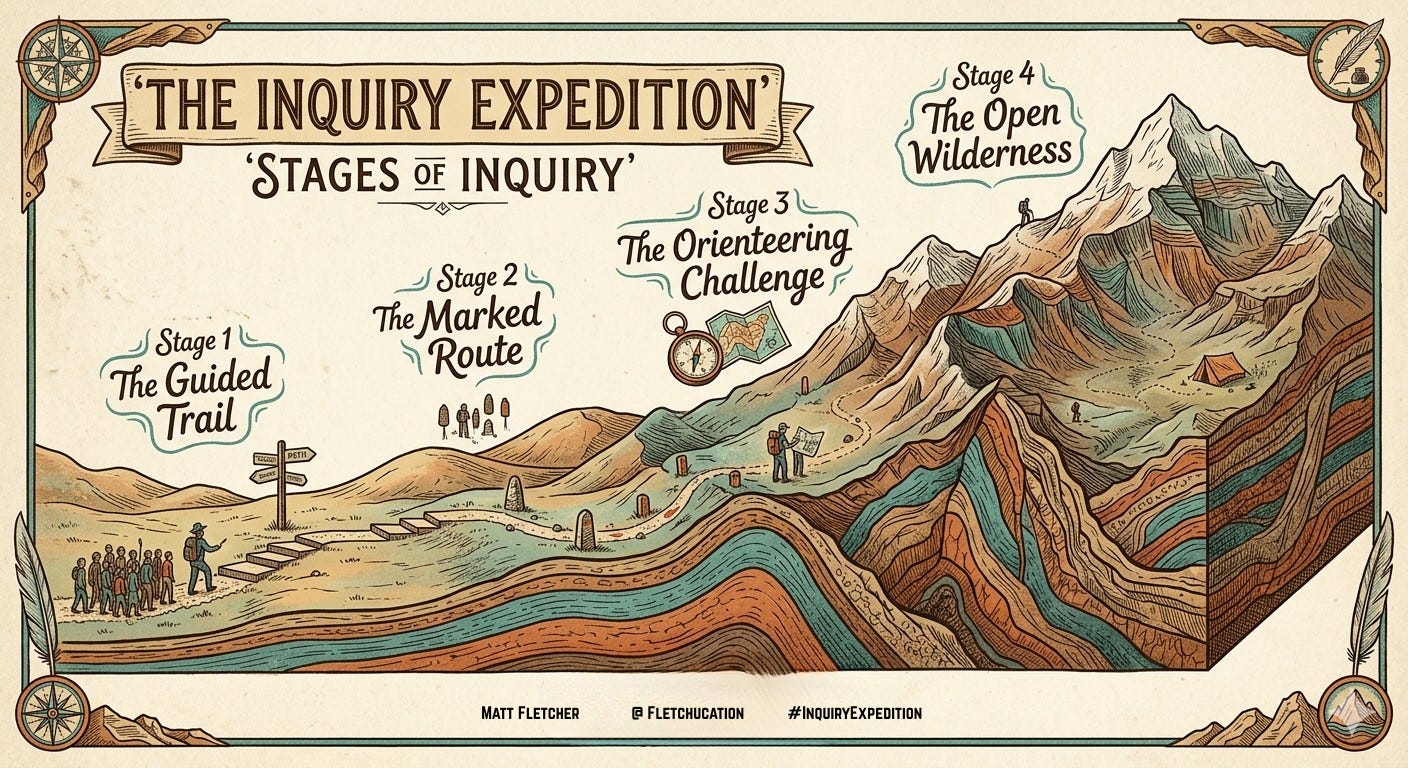
Welcome to Fletchucation. I’m Matt — a secondary English teacher, MA researcher, and someone who has spent over a decade trying to figure out what genuinely great inquiry-based learning looks like in a real classroom. This is a new beginning, and I want to start with a story.
I remember the lesson clearly.
It was a Year 12 English class. IB Diploma. The kind of class that, on paper, should have been thriving in an inquiry-based learning environment. The school was committed to it. The curriculum was built around it. I had planned what I genuinely believed was a strong, student-centred lesson.
About twenty minutes in, a student put up her hand.
She was bright, hardworking, and genuinely invested in doing well. She looked at me with an expression I have thought about many times since, somewhere between frustration and confusion, and said something I was not expecting.
“Can we just focus on what we need to know for the exam? All this questioning and exploring — I don’t really see the point of it.”
The room went quiet.
And honestly? In that moment, I did not have a good answer.
I had been teaching in international schools for several years by that point. I had attended the workshops, read the research, and genuinely believed in what inquiry-based learning promised. I was doing everything I was supposed to be doing.
But that student had identified something I had been too close to see.
I had been asking my students to inquire without ever truly preparing them for what inquiry required of them. I had given them the questions without giving them the tools. I had opened the door to the expedition without teaching them how to navigate the terrain.
She did not need less inquiry. She needed better preparation for it.
That moment stayed with me for years. It was one of the reasons I eventually undertook a Master of Arts in Education, researching the challenges teachers face when implementing inquiry-based learning in practice. And what my research kept pointing back to, quietly but consistently, was the same gap that student had named in that Year 12 classroom.
Student readiness. It was the missing piece.
Not the curriculum. Not the resources. Not even the professional development, though that matters enormously. The missing piece was that nobody had systematically equipped students for the experience of genuine inquiry. We assumed that if we built the environment, the thinking would follow.
It doesn’t. Not automatically. Not without preparation.
That realisation is what led me here.
Over the past year, I have been writing a book. It is called The Inquiry Expedition: A Field Guide to Student Readiness, and it is the book I wish I had had in that Year 12 classroom.
It is built around a framework I call the Inquiry Compass — four cardinal points that together map everything students need to be genuinely ready for inquiry-based learning:
North — Navigate. Sparking curiosity, building powerful questioning skills, and developing the daily habits of wonder that sustain an inquirer over time.
East — Explore. Building the collaboration skills, independent research tools, and scaffolded confidence students need to venture into the terrain of inquiry.
South — Synthesise. Equipping students with the thinking routines and argument-building frameworks that turn gathered evidence into genuine understanding.
West — Weave. Helping students share their learning authentically, reflect deeply, and set their compass for the next expedition.
Every chapter is practical. Every strategy has been tested in real classrooms. Every tool is downloadable free at expedition.fletchucation.com.
And the book is coming soon.
I want to be honest about something before I go any further, because I think it matters and because I have read too many books about inquiry-based learning that do not say it clearly enough.
This is hard.
Getting students genuinely ready for inquiry takes time, patience, and a willingness to sit with uncertainty. There will be lessons that do not land the way you planned. There will be students who resist the invitation to take ownership of their learning. There will be moments where the effort feels disproportionate to the outcome.
But here is what those years of research and classroom practice have consistently shown me: when students are genuinely prepared for inquiry, the quality of their thinking, their engagement, and their academic performance is transformed. The student who asked me to just help her pass the exam went on to do extraordinarily well in her IB Diploma. She was always capable. She just needed the tools.
That is what this book is for. And that is what this Substack is for.
Every fortnight, I will share:
Practical strategies from the book you can use immediately
Classroom stories from over a decade of inquiry teaching
Honest reflections on what works, what does not, and what I am still figuring out
Updates on The Inquiry Expedition series as it grows
It is free. It is for teachers. And it is built on the belief that the best professional development happens in conversation between practitioners who are genuinely trying to do right by their students.
If that sounds like you, I am glad you are here.
The expedition is just beginning. 🧭
The Inquiry Expedition: A Field Guide to Student Readiness is coming soon. Visit expedition.fletchucation.com to learn more or subscribe here and be first to know when it launches.
Follow Me on social media: @fletchucation