


I had asked my class to generate their own inquiry questions. We had spent a lesson on the provocation. The curiosity journals were open. The room had been buzzing. And now it was time to see what they had come up with.
A student raised his hand confidently. He had clearly thought about this. He read his question out loud.
Is Ralph a good leader?
The class waited. I waited. Then another student said, quietly but audibly: Yes. Obviously.
And that was it. The question was dead before the inquiry had begun.
The student who asked it was not lazy or disengaged. He had genuinely tried. He had looked at the text, identified something relevant, and formed a question about it. But the question he had asked could be answered without thinking. And a question that can be answered without thinking is not an inquiry question. It is the end of one.
I have seen this moment play out in classrooms many times. Students who have spent years being asked questions with right answers do not automatically know how to ask questions without them. They need to be shown.
That is what this post is about.
The Problem With Surface Questions

Most students arrive in our classrooms having spent years in an environment where questions have right answers. Where the purpose of asking is to demonstrate knowledge, not to generate it. Where the safest question is the one you already know someone can answer.
That environment produces surface questions — questions that can be answered without genuinely thinking. A single word, a yes or no, a recalled fact. They close down thinking rather than opening it up. And once you have the answer, there is nowhere interesting to go.
Surface questions are not wrong. They are often necessary starting points. But they are not the engine of inquiry. They are the foyer, not the room.
The room is where the deep questions live. And getting students into that room requires explicit teaching.
What Makes a Question Deep?

A deep question cannot be answered without thinking. It requires interpretation, judgement, or analysis. It connects to something that genuinely matters — to the student, to the subject, or to the wider world. It opens outward rather than closing down.
And perhaps most importantly: it makes the person asking it genuinely want to know the answer.
That is the test. Does this question make you curious? Does it pull you forward? If the honest answer is no — if the question feels like something you are supposed to ask rather than something you actually want to know — it needs to go deeper.
From Surface to Deep: The Process

Here is the process I teach students. Work through it once with me using a real example.
Our surface question is: Is Ralph a good leader?
It is the kind of question that appears in classrooms everywhere. And it is a surface question — not because it produces a list, but because it can be answered without thinking. Yes or no. Done. There is nowhere interesting to go from there.
That is the test for a surface question: can it be answered without genuinely thinking? If yes — a single word, a yes or no, a recalled fact — it is surface. Keep going.
Step 1 — Identify why the question stays shallow.
Is Ralph a good leader? invites a judgement but closes it down immediately. Yes or no. It does not ask what kind of leader, why leadership matters, what leadership reveals, or what we are assuming when we call someone good.
Ask yourself: what is this question not asking that it should be?
Step 2 — Pick a question starter and use it to rewrite the question.
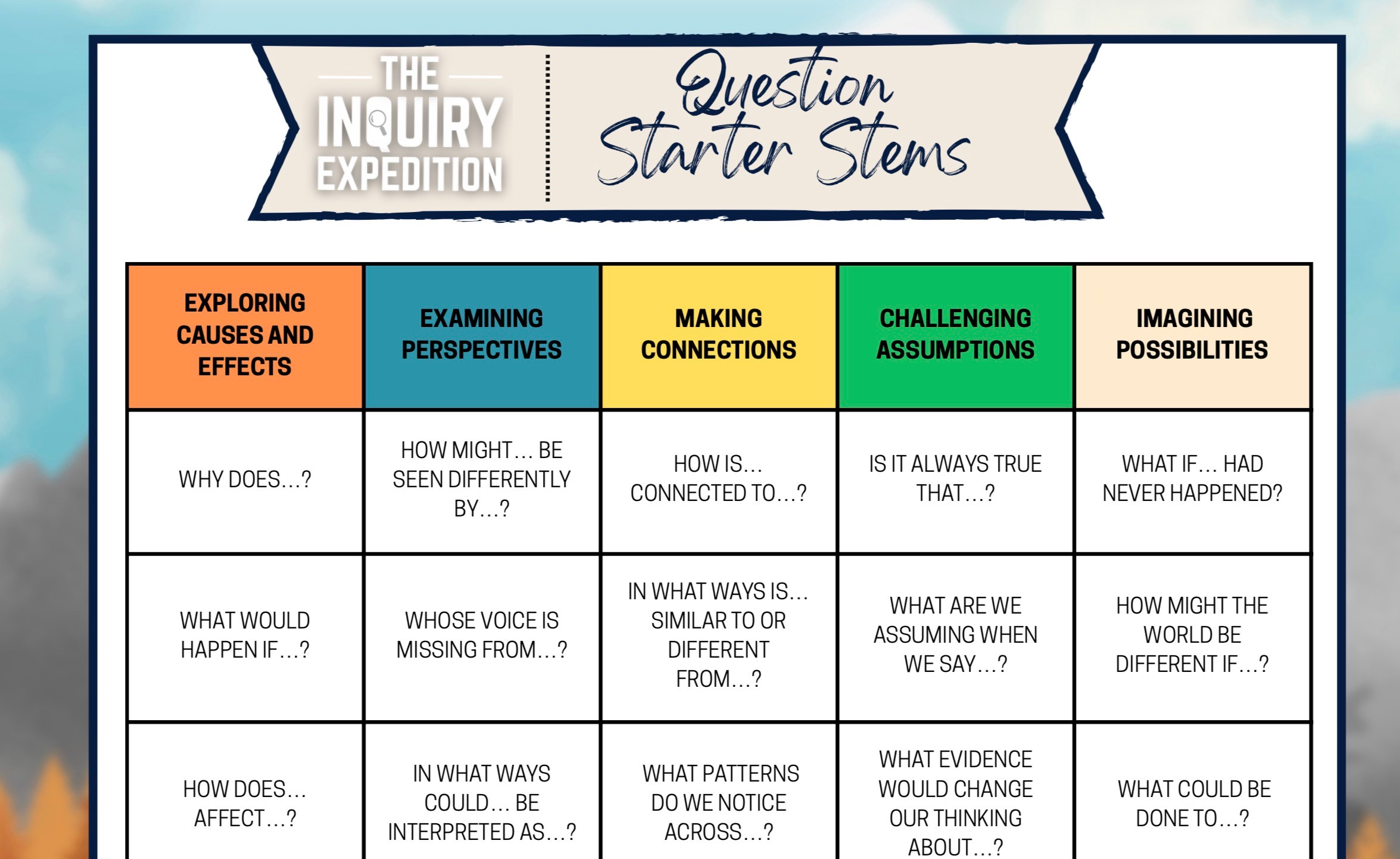
To push a surface question deeper, try starting your new question with one of these:
- Why… (causes)
- How might… (perspectives)
- What would happen if… (possibilities)
- Whose voice is missing from… (perspectives)
- In what ways… (connections)
- Is it always true that… (assumptions)
- What if… (possibilities)
- How does… connect to… (connections)
- What are we assuming when… (assumptions)
The full Question Starter Stems Card — five categories, fifteen stems, designed for classroom display — is available free at the end of this post. Download it and keep it. It is the tool behind everything in this post.
Pick one starter and apply it directly to your surface question. Here is what happens when we try three different starters on Is Ralph a good leader?
Using What are we assuming when…
What are we assuming when we call Ralph a good leader?
Using How might…
How might Ralph’s leadership look different through Piggy’s eyes?
Using What would happen if…
What would happen if Jack had been chosen as leader from the very beginning?
Three completely different deep questions. All from the same surface question. All using a starter directly.
Pick the one that makes you most curious. That is your improved question.
Step 3 — Push it outward by connecting beyond the text.
Ask yourself one of these:
- How does this connect to something I already know or have studied?
- How does this connect to the real world today?
- How does this connect to my own experience?
- How does this connect to another text I have read?
Using our example:
What are we assuming when we call Ralph a good leader?
becomes
What are we assuming when we call Ralph a good leader, and does the novel ever let him be one?
That is a deep question. It requires thinking, not recall. It opens outward rather than closing down. And it makes you genuinely want to find the answer.
Now Use the Stems to Generate Brand New Questions
The same stems that helped you improve a surface question can also help you generate entirely new inquiry questions from scratch — not improving what you have, but creating what you do not yet have.
Take Lord of the Flies as your starting point. Use one stem from each category and write a fresh question. Do not worry about whether they are perfect. Just generate.
Here is what that looks like:
How does the breakdown of authority change each character in Lord of the Flies?(causes and effects)
How might this novel read differently to someone who has experienced real conflict?(perspectives)
In what ways is the society the boys create similar to political systems we see in the world today? (connections)
Is it always true that children are more innocent than adults? (assumptions)
How might the novel end differently if the boys had been rescued in the first week?(possibilities)
Five deep questions. Generated in minutes. Using the same stems.
Putting It Together: The QFT
The Question Formulation Technique brings everything above into one structured classroom process. I wrote about this in a previous post below.

Students start with a provocation. They generate questions freely — surface and deep, everything, without judgement. They use the steps above to improve their surface questions. They use the stems to generate new deep questions they had not thought of before. Then they prioritise — which question matters most? Which one, if they could answer it, would change how they see everything else?
That final question becomes their driving question. And it belongs entirely to them.
That is when the real learning begins.
How I Use This in Class
I introduce the two skills separately and in sequence.
First, the transformation. I put a surface question on the board — always one that students will recognise from their own experience of school — and we push it together. What is the question behind the question? We try it two or three times as a class until students can feel the difference between a surface question and a deep one.
Then, the five moves. I give students a topic or provocation and ask them to generate deep questions using each move. We share what we produce and notice which moves produced the most interesting questions for this particular topic.
After a few weeks of practising both skills, something shifts. Students start doing it automatically. They write a surface question, recognise it, and push it further before they have even finished the sentence.
That is the goal. Not a lesson about questioning. A habit of questioning.
The Free Download
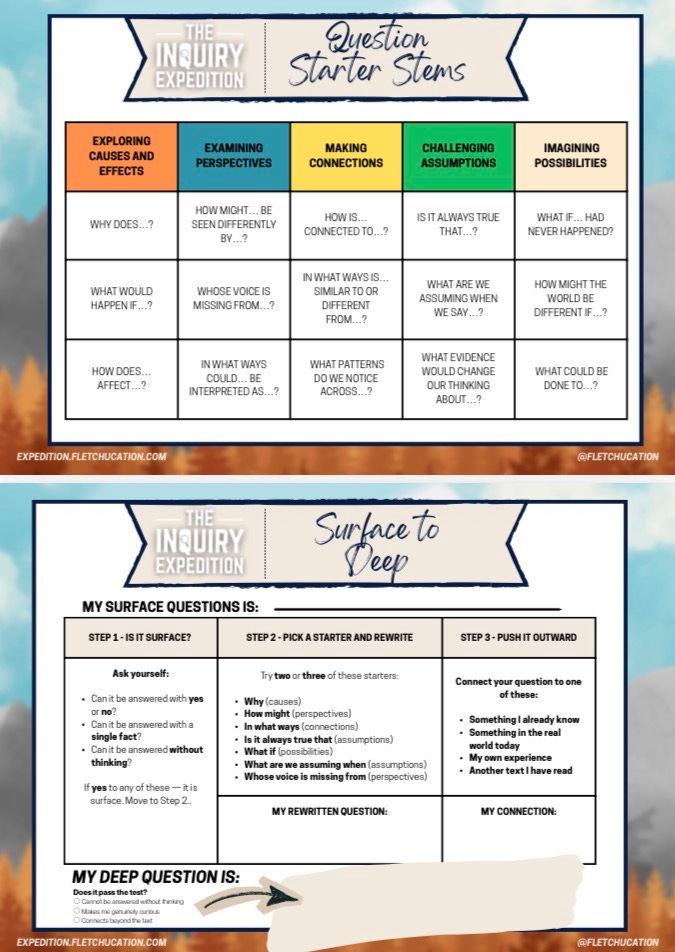
Two tools in one download — both free:
The Surface to Deep Transformation Worksheet — a one page student worksheet that walks through the three step process with space to practise. Use it as a class activity, a warm up, or a homework task at the start of an inquiry unit.
The Question Starter Stems Card — the full five category framework with all fifteen stems, designed for classroom display or to give to every student at the start of a unit.
A Note on Paid Subscriptions
If you are finding these posts useful and want to support Fletchucation, paid subscriptions are now open.
Paid subscribers receive a free ebook copy of A Book of Provocations: Volume 1 — fifty thought-provoking images across five categories, each with discussion questions and predictive prompts ready to use in class, worth $18 USD.
Every subscription also helps keep this newsletter going. And if I am being completely honest, it helps sustain a coffee habit that the Bavarian espresso scene has made significantly worse.
The surface to deep questioning framework is explored in depth in The Inquiry Expedition: A Field Guide to Student Readiness, coming soon. Join the waitlist at expedition.fletchucation.com or subscribe here.
If this post was useful, forward it to one teacher who might need it. That is genuinely the best thing you can do to help Fletchucation grow.
Follow @fletchucation on Instagram and Threads for more.
This is such a great progression!