


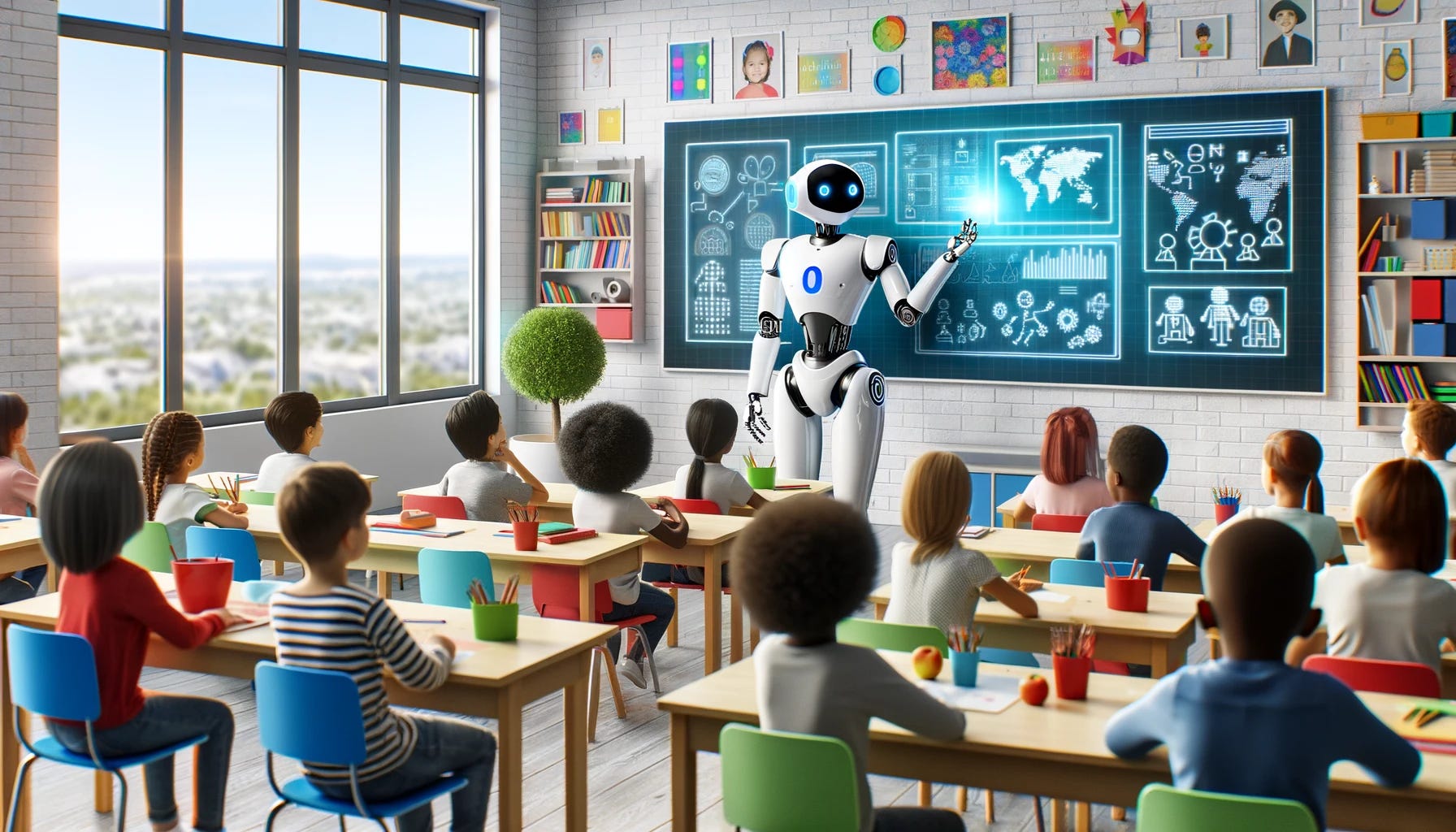
Look at the image above for thirty seconds before you read on.
Do not analyse it. Do not rush to conclusions. Just look.
What do you notice? What does it make you think? What do you want to know?
The image is called Tomorrow’s Classroom. It comes from a book I published called A Book of Provocations: Volume 1 — a collection of fifty thought-provoking images across five categories, each one designed to spark genuine discussion and inquiry in the classroom.
This particular image sits in the Human Ingenuity category. And it raises questions that I think matter enormously for every teacher reading this right now.
Now Try This
Write down every question this image raises for you. Do not edit them. Do not judge them. Just write.
Go. Gvive yourself 7 minutes.
You probably have a list now. Some of those questions will be what I call surface questions — immediate, factual, answerable with a quick search:
Is this what classrooms will actually look like? What subject is being taught? Are the students engaged?
These are fine questions. They are the starting point. But they are not the questions worth inquiring into.
Now look back at your list and ask yourself: which of these questions opens into something bigger? Which one, if you pursued it, would take you somewhere genuinely interesting?
Push those questions further. What is the bigger, harder, more important question hiding underneath?
A surface question like will robots replace teachers? becomes something far more interesting when you push it: what is it that only a human being can offer a learner, and how do we know?
What subject is being taught? becomes does it matter what is taught if how it is taught has fundamentally changed?
Are the students engaged? becomes what does genuine engagement actually look like, and can a machine ever produce it?
These are the questions worth sitting with. These are expedition questions.
The Tool Behind This: The QFT
What you just did — generating questions freely and then pushing them deeper — is the foundation of a structured technique called the Question Formulation Technique, developed by the Right Question Institute.
The QFT gives students a framework for doing exactly this, step by step:
Step 1: Generate questions freely from a provocation. No editing. No judging. Just write.
Step 2: Categorise them. Which are closed — answerable with yes, no, or a single fact? Which are open — requiring exploration and interpretation?
Step 3: Transform. Take your closed questions and rewrite them as open ones.
Step 4: Prioritise. Which question matters most? Which one, if you could answer it, would change how you think about everything else?
Step 5: Reflect. What did you notice about how your questions changed as you pushed them further?
The image above is a perfect QFT starting point. And so are the other forty-nine images in A Book of Provocations: Volume 1.
Two Books, One Journey
A Book of Provocations: Volume 1 gives you fifty images like this one, organised into five categories, each with three predictive questions and ten discussion questions per image. It is a ready-made scaffold for getting students talking, wondering, and beginning to question. It is a great resource I personally used with my DP English B students in preparation for the oral examination.
You can get it here: A Book of Provocations: Volume 1
And when your students are ready to go further — to move from discussion questions into genuine self-directed inquiry — that is where my upcoming book The Inquiry Expedition: A Field Guide to Student Readiness picks up.
One of the core frameworks in The Inquiry Expedition is what I call the surface to deep questioning spectrum. It gives students a concrete way to understand the difference between questions that close down thinking and questions that open it up — and a practical process for moving from one to the other. The QFT sits at the heart of that framework, alongside curiosity journals, concept mapping, and a complete unit opening sequence that takes students from their first provocation all the way to a driving question that belongs entirely to them.
Think of A Book of Provocations as the spark. The Inquiry Expedition as the trail that follows.
A Note on Supporting Fletchucation
If you are finding these posts useful and want to go deeper, consider becoming a paid subscriber.
Paid subscribers get an ebook copy of A Book of Provocations: Volume 1 — fifty provocations, five categories, three predictive questions and ten discussion questions per image — worth $18 USD, yours as a thank you for your support.
Every paid subscription also helps keep this newsletter going. And if I am being completely honest, it helps sustain what has become a fairly committed coffee habit. The Bavarian countryside is beautiful but the espresso is not going to drink itself.
The Inquiry Expedition: A Field Guide to Student Readiness is coming soon.
If this post was useful, forward it to one teacher who might need it.
Follow @fletchucation on Instagram and Threads for more.
Great post, especially enjoyed the QFT references and your guidance through that. This post gives us food for thought on how to bridge students from factual to interpretive question generation. Thanks!
I will, I really like the approach of asking for a question instead of asking for an answer. Especially with graphics, I have noticed that my students struggle to extract information from visual display (including models, maps, tables and graphs) so I try to have a few minutes every class to sit with a visual